Showing posts with label Composition. Show all posts

Sunday, August 31, 2014

Go In Peace

I took some time this Labor Day weekend to record my little song "Go In Peace" with my two older kids. I wrote this song last year as an exit song for our weekly Meeting for Worship time in the Lower School (oops! I say "yearly" on the video. I was quite distracted by my 1-year-old busy destroying the house off-screen). Here it is:


The lyrics:
Go in peace, go in peace
With this blessing in your heart
May your light shine brightly wherever you are.

Go in peace, go in peace
May this silence teach us grace
To help each other make the world a better place.

Feel free to use this song if it works for you, but please let me know in the comments!

Friday, June 28, 2013

ThumbJam--a powerful virtual instrument for everybody!

I included ThumbJam in my original iPad app lists, and not only do I still think it's one of the best virtual instrument apps out there, it's received a huge number of new features in the last two years. Oddly, I found out after my first mini-review that the developer and I not only grew up in the same smallish town, we shared a childhood best friend. Major small-world moment!
Though ThumbJam includes a high-quality library of sampled real instruments, from flute and violin to accordion and electric guitar, its interface does not attempt to imitate any of these. Instead, it is made up of a user-controllable number of parallel horizontal bars representing pitch. Part of the beauty of ThumbJam is how easy it is to jump in and play. Select an instrument, select a scale (a large selection of scales such as major, minors, blues, etc. is built-in, or you can create your own), and start playing!
Though it does work well to play with two thumbs, as the app name suggests, you can use more fingers if you like! Most instruments allow you to create vibrato and/or tremolo with your fingers, and some allow pitch bend by tilting or volume control along the horizontal bar. With some practice, it's possible to create a quite expressive solo.

Sunday, September 4, 2011

First Week of School!

2011-12 is off to a great start! This first week of school, my fourth at CFS, has been a very different one for two reasons. First, I've spent it almost entirely in the Middle School in preparation for my first year as an advisor (more on that in a moment). Second, my daughter just entered the Lower School as a first-grader! Hopefully I won't be jinxing anything by saying this, but M's first week of Lower School has been absolutely incredible. She has literally been bouncing up and down from the time she gets out of bed until lights-out at night. She has been slightly indignant that I hadn't revealed every detail of the Lower School to her ("WHAT??? We get to do WOODWORKING in River class???"), and she is quite anxious to start music class with me next week. I must say, that creates a bit of anxiety for me, as well. For better or worse, I will be her music teacher twice a week for the next four years and beyond!

Ever since I started teaching in the Middle School, I have wanted to be an advisor. Advisee groups are the heart and soul of the CFS MS. Much more than a homeroom or source of academic advice, each advisee group serves as a year-long (or, in many cases, 2-, 3-, or 4-year long) mixed-age family for each student in the school. Made up of 8-12 students in the 5th-8th grades, groups have long meetings twice a week, take care of their advisor's classroom each day, and can check in with their advisor any time. Advisors serve as each advisee's advocate in the MS and a first point of contact for parents and teachers. Advisee groups perform service projects together, participate together in special events (such as the famous "Egg Drop" competition on Science Day), and go on two Advisee Outings each year.

Generally, part-time staff in the MS are not advisors because advising is practically a full-time job in itself! However, my situation is a bit unusual in that I am a full-time faculty member at CFS, and my schedule is already compatible with the advisor schedule with only a little tweaking. So this first week of school, for the first time I have been an Orientation Group leader in the Middle School, instead of splitting my time visiting both units. OG's are temporary groups until everyone goes through the advisor selection process over the next two weeks. I've had a great experience with my OG so far and it will be difficult letting them go! I also REALLY miss my Lower Schoolers and can't wait to see them all next week. Teaching kids all the way from age 6 to 13+ is, for me, a favorite aspect of my awesome job, and I feel out of balance when I'm only in one unit all week.

Regular classes start after Labor Day in both units. I have lots to look forward to this year besides my advisee group! Here are a few highlights:

  • I'll be going all-out with technology integration this year in the Lower School. I have acquired four iPads and one iPod touch (soon to be two) that I will be using as a regular part of my composition-based curriculum along with my interactive whiteboard, student MacBook, and donated older iMac (thanks Dad!). I'll be updating regularly on the blog and can't wait to share the results of our projects.
  • I have a new resolution this year to never have a Lower School music class without singing! I'm already pretty good at this–I can probably count last year's 1st- and 2nd-grade classes without singing on one hand–but I tend to slip in the 3rd and 4th grade as we spend more time on recorders and other instruments. One of my major goals as a music teacher is to obliterate the statement "I can't sing," and I think this is a very important step.
  • I'll be teaching my "Musician's Workshop" elective for the second time this Fall in the Middle School. I loved this class last Fall, but I also feel that I learned a lot of things from last year's kids that I will be able to use to create an even better experience for young musicians this year. My top goal in this class is to do a better job with differentiation, so that my beginner composers learn as much as my experienced musicians. I hope that, over time, student musicians will see this as a repeatable class they can use each year to build their skills and create exciting new projects.
  • One last resolution... I will keep my blog current throughout the year instead of posting occasional gigantic updates. I won't go so far as to commit to a specific number of updates, and I won't overwhelm parents with daily updates, but I WILL post more consistently.

Here's to an exciting new year! Happy Labor Day!

Thursday, June 23, 2011

iPad apps Mega-Update part 5: Musical Instrument apps

Edited 6/15/13: I see these posts are still getting a lot of traffic, two years later! Much of this info is outdated. However, I am working on updating my iPad app pages for 2013! I'll post to my blog as updates are completed, or you can check the page directly.

_____________________________________________


It's tough to even scratch the surface of the multitude of musical instrument apps in the App Store. I've not included some of the hardcore apps such as the amazing Korg synthesizer apps, Reactable, etc., because they are really intended for serious electronic musicians and aren't as suited to use in the lower and middle school classroom. I'm sure I'll be updating this list frequently!
  • Aeolian Harp: This is a beautifully relaxing instrument that creates gorgeous images as you play. More for personal meditations than use in the classroom.

  • Accordéon: This app takes over your screen and turns it into a full-sounding accordion!

  • Bebot: This adorable little robot is actually a highly functional synthesizer.

  • Celtic Harp: This full-screen, customizable harp has a beautiful, soothing sound.

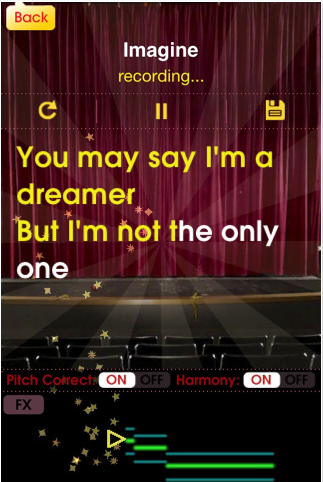
  • Glee Karaoke: If you don't mind the "Glee" branding, this is the best Karaoke app for iPad. Progress through songs and try to beat your high score (based on pitch and rhythm), and listen to top performances from around the world!

Screen shot 2011 06 25 at 12 01 20 AM

  • iGuzheng: A nice introduction to a popular Chinese zither. This app features beautiful demo songs and multitouch functionality for different effects.

  • iTabla Pro: If you are an Indian music performer or enthusiast, iTabla Pro is an incredible practice partner. 32 fully configurable taals are available, with table, two 5-string tanpuras, a shruti box, and more. iTabla can auto-tune to match your instrument. This is yet another example of an app that exceeds the performance of a dedicated hardware device, for a fraction of the cost. As far as apps go, though, this one is pricey ($25).

  • Magic Fiddle: Smule's Magic Fiddle is an expressive little virtual bowed stringed instrument. Go through a series of lessons, and share your performances with the world.

  • Magic Piano HD: An assortment of simplified keyboards, "light beams" to help you play classic tunes, and a social networking component make this another addictive app from Smule.

  • Melody Bell: I grew up playing handbells, so when I saw this app as part of the North Point iBand Christmas extravaganza, I had to have it! It's not a universal app, but the iPhone app looks great and is easier to play on the big screen.

  • Ratatap Drums: There are many virtual drum sets in the app store, including the nice one built in to GarageBand. Ratatap is one of my favorites of the dedicated drum apps.

  • ThumbJam: ThumbJam is a unique instrument designed completely for the iPad (and iPhone). 30 high-quality sounds are included, and in addition to your fingers (and thumbs!), this app uses the internal gyroscope as a controller. It also functions as a looper, and is compatible with AudioCopy/Paste. The configuration options and the fact that it doesn't rely on knowledge of real instrument technique make it excellent for the general music classroom.

  • YumiSynth: This is a unique bowed string simulator, in which one hand "bows" the instrument while the other fingers the notes. YumiSynth can be a highly expressive instrument with a little practice.

  • 50 in 1 Piano HD: There are probably hundreds of piano apps in the app store. Out of the ones I've tried, 50 in 1 Piano is one of my favorites. In addition to a good piano sound, it has 49 more high-quality sampled instruments, effects, drumbeat loops, and 120 piano lessons, and more.


Thursday, September 16, 2010

Welcome Back, Middle School!

I wish I could say Fall was in the air, but at least it has been beautifully sunny for our first weeks of Middle School. Today students will find out their advisors and advisee groups for the year, so the school is simply buzzing with excitement. Good luck to all the morning class teachers...

The first week of school was spent reclaiming my teaching space, which involved hefting a lot of heavy equipment into the loft, setting up the new digital piano (woot!), and reorganizing. The space is now being used for a morning math class, so that’s an extra incentive to keep it clear and clean. My rather firm “keep out unless you have a teacher’s permission” sign is now complemented by a beautiful name sign made by David. Thanks, David!!
As usual, I’m teaching 3 electives this trimester: First-year Music Rotation (required of all 1st-years), Ukulele, and a new class called Musicians’ Workshop.
They get younger every year.
I’ve been kicking off Music Rotation with the same listening exercise and debate since I started teaching it. One of my goals as a music teacher is to open students’ ears to the huge variety of music in the world, and recognizing that while the existence of music is universal, the way you interpret it is heavily influenced by your culture and experiences. We listened to ten excerpts from around the world, from Bob Marley to Tuvan throat singing. After sharing our first reactions to the music, the whole class worked to come up with a definition of music that we could all agree on. That is much harder than it seems! Some of the things these 10-year-olds were arguing about included whether music requires instruments (because if it makes music, it’s an instrument, right?), whether music you imagine in your head can be called sound or even music, and whether nature sounds can be considered music if there isn’t a human there to hear it as music. Finally, I shared with them composer Edgar Varese’s famous definition, “Music is organized sound.” That led to a discussion of what the words “organized” and “sound” actually mean, which led to... well, you get the idea.

Since those first two lively classes, we’ve been reviewing our drumming skills from Lower School and learning new rhythm games and hand drum techniques.


Middle School ukuleles are back! 6th period is our ukulele elective, and students have just received (and decorated) their very own ukuleles. So far we’ve learned to tune our ukuleles (an ongoing process, and one we get to practice quite a bit as the new strings stretch out), the names of the strings, the C, F, and G7 chords, and several songs including “Kookaburra,” “Simple Gifts,” “Black Socks,” and “You Are My Sunshine.” We also just started learning the C scale, a gateway to finger-pickin’ fun.

I’m very excited about my 7th period class, Musicians’ Workshop. You may have read my blog entry about composition in the classroom. I’ll be bringing a lot of composition into the Lower School and MS 1st-year rotation this year. Musicians’ Workshop a class for older Middle Schoolers, focused on creative composition. Our first exercise was for each student to become a “key” on an instrument by coming up with a short, repeatable sound or rhythm. Then each student had a turn as the composer, in which they used hand signals to “play” the keys of their instrument. Much fun was had! We then listened to four very different pieces of music: a Bach cello partita, a song for flute and cello, with both players singing while playing, by Persian-American composer Reza Vali, Sarah McLachlan’s “Angel,” and U2’s “Beautiful Day.” We noticed similarities and differences, and that the pieces from the same genre actually had less in common than the pieces from different genres. Again, we’re working to open ears, but at a more detailed and thoughtful level.

We’re now working on our first composition assignment, in small groups. Stay tuned for some audio clips!

Thursday, July 15, 2010

Can Every Child Be a Composer?

Can you imagine language arts class with no original writing? K-8 art class in which students only copy pictures? K-8 music class without students creating their own pieces of music? Of those three questions, I would dare to guess that most Americans would answer “yes” only to the third. As my career has shifted from performer to music educator, I’ve been thinking about my history as a composer and the tendency of American music education to focus on performance over all other aspects of our art. I’ve spent much of my creative life wanting to become a composer, but only in recent years have I been able to accept that I don’t have to be the next Bach or Stravinsky to be a composer—I in fact have been a composer since the age of 5. My first few years as a pianist resulted in such gems as “I’m Being Eaten By an Alien” and “Pig Dance.” However, the more I learned about music in traditional lessons, the more intimidated I became. My culture’s music seemed to be made up of a million rules, and every piece I learned on the piano, violin or flute was vastly superior to my compositional experiments. I had a passion for music, a desire to express myself through composition, and an attitude supported by much of Western musical culture that composers are born, not made. The latter gave me such an inferiority complex that I rarely composed for years, and even more rarely shared my compositions with others. It wasn’t until college that I began to experience composition in a new way. 

My first official composition class (after many, many music theory classes) was with Prof. Allen Anderson his very first semester at UNC-Chapel Hill. His classes were one revelation after another, but it was the very first assignment that made the biggest impact. We had to write and perform a composition with these rules: the instrument could not be something normally used to make music, and we had to invent our own musical notation specific to our new instrument. To a traditionally trained classical musician, it was the most freeing assignment imaginable. I made music with my three juggling clubs, and never looked at a household object the same way again. More importantly, I started to begin to be able to imagine music without all the rules, just like when I fell in love with the piano as a young child. I began to study composition with a much more open mind, and collaborated with up-and-coming composers as a performer, culminating in a recital in Los Angeles of all new works for the flute. The more I develop as a composer, the more I’m able to personally blur the lines between performer, composer, improviser, and listener.

My journey as a composer was a struggle for many years, yet I felt compelled to continue even when I really didn’t understand why. I think this sentence, by Michele Kaschub and Janice Smith in Minds on Music, sums up my feelings:
Composers work at the vast frontier of music-a place where knowledge and possibility are always twisting and turning in elaborate dance.

Knowledge and possibility. Should these not be the foundation of an arts education curriculum? I hope they apply to everything I do as a teacher, whether it’s the knowledge of a particular musical tradition and the possibilities within it, or the knowledge of one’s own inner world and the possibility of expressing it through original music. For years I was stuck in a downright snobby thought pattern that if music (or art in general) wasn’t completely unique and groundbreaking and wonderful, that it wasn’t worth making. But music belongs to everyone, not just the professional performers. Every child deserves the chance to express themselves through the arts, not just imitate. Music is a natural language of children, especially if they are immersed in it in their early years. Every day my 5-year-old daughter expresses herself through original music—whether making up a silly song or acting out strong feelings through an instrument. All too often, the knowledge children accumulate puts a damper on their formerly limitless sense of possibility. The preschooler is a composer, an improviser, a fabulous singer! The fourth-grader has often already decided they “can’t sing,” they “aren’t musical,” and certainly they “can’t compose.”  The arts are one field where possibilities should only increase with knowledge!

Implementing a composition curriculum is a huge topic and the subject of, well, not enough books—but certainly it should be! I’ll be posting about my journey during the new school year, and have already found some wonderful resources online. Technology is also on my side—despite the disadvantages of living in a culture of music consumption rather than music-making, the modern teacher has a wealth of truly useful technological tools available, from music notation software (e.g. Sibelius) to music production software (e.g. GarageBand), to online collaborative music-making communities (e.g. Indaba). I’ve already discovered many of the joys and pitfalls of teaching composition through GarageBand in the CFS Middle School. In addition to expanding that program, in the upcoming year I plan to implement the most changes in my youngest students’ classes. Those students will potentially be my music students for up to 8 years, so they will be my first test subjects for a progressive composition curriculum. Stay tuned to my blog to track their progress!

Wednesday, December 31, 2008

I finished--Please vote for me!

With the help of my laptop, my new software, and a random assortment of my nieces' toy instruments, I managed to complete an entry to the Yo-Yo Ma remix contest at Indaba Music while on vacation! Please listen to my entry, and if you like it, I'd really appreciate your vote. You can click the link on this widget, or go here: http://www.indabamusic.com/submissions/show/4674